What a Forex Broker Licence Does, and What It Does Not
What a forex broker license requires, what it cannot protect you from, and how to verify one in five steps. Covers clone firms and compensation schemes.
By Nexora Capital Markets — Editorial team
Published: Oct 27, 2026
Updated: Oct 27, 2026

Table of Contents
A licence is one of the most used and least examined words in trading. It appears in every website footer and most adverts, usually with nothing else attached.
A forex broker license matters, but only once you know what it actually means. This guide explains what a license obliges a broker to do, what it cannot do for you, and how to check one yourself in a few minutes.
Key takeaways
• A license is permission from a regulator for a named company to provide named services, under conditions.
• It sets rules for how the broker operates. It does not protect you from trading losses.
• Protections differ between regulators, so ask which ones apply to your account.
• A license covers only the entity named on it, not every brand or company nearby.
• Always verify on the regulator's own website, never through a link the broker sends you.
1. What a forex broker license is
A license is authorization from a financial regulator for a specific company to carry out specific activities, such as dealing in forex and CFDs, subject to ongoing conditions. Three details define it: the regulator, the license number and the exact legal entity it was issued to.
It is not permanent. Regulators can add conditions to a license, suspend it or withdraw it, which is why the current status on the regulator's register matters more than a logo on a website.
2. What a license typically requires
The detail varies by regulator and by licence category, but a licensed broker is generally expected to meet standards in areas such as:
• Management: the people running the company are assessed as fit and proper.
• Capital: the company holds a minimum level of its own funds.
• Client identification: verifying who clients are, to prevent fraud and money laundering. This is why you are asked for documents.
• Reporting and audit: submitting financial information to the regulator and having accounts audited.
• Disclosure: publishing risk warnings, client agreements, and terms.
• Complaints: having a process for handling client complaints.
Treat this list as the questions to ask rather than a promise of what applies. The broker should be able to tell you which obligations its licence carries.
3. What a licence does not do
A licence does not... | What that means for you |
|---|---|
Protect you from trading losses | Losses from market movements are yours, however closely the broker is supervised |
Guarantee a compensation scheme | Some regulators run one and many do not; ask what applies to your account |
Cover every related brand or company | Only the entity named on the register holds the licence |
Make a service available everywhere | A licence permits activity under one regulator's rules, not in every country |
Endorse a product or a strategy | Regulators supervise firms; they do not recommend trades or promise results |
Last for ever | Status can change, so check the live register rather than an old screenshot |
4. Where a company is registered versus who licenses it
It is common for a broker's company to be incorporated in one jurisdiction and licensed by a regulator in another. Incorporation is about where the company legally exists; the licence is about which regulator supervises the services it provides. Both details should be published, and both should match your client agreement.
Our own details are a worked example: Nexora Capital Markets Ltd (Company Number: 237992 GBC) is licensed by the Financial Services Commission of Mauritius (licence no. GB26206605). You can check the licence using the five steps below.
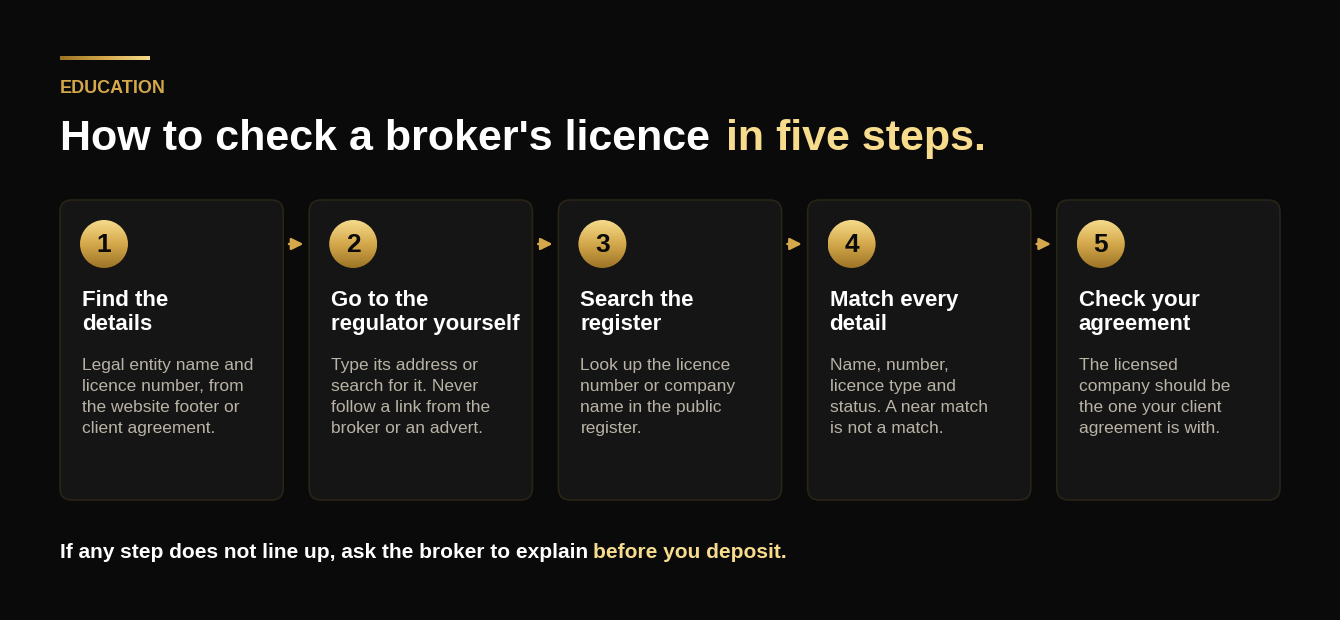
5. How to check a broker's licence in five steps
1. Find the details. Take the legal entity name and licence number from the broker's website footer or client agreement.
2. Go to the regulator yourself. Open the regulator's official website by typing its address or searching for it, rather than following a link from the broker or an advert.
3. Search the register. Look up the licence number or company name in the regulator's public register of licensees.
4. Match every detail. Company name, licence number, licence type, and status should all match exactly. A near match is not a match.
5. Check your agreement. Make sure the licensed company is the one your client agreement is actually with, not a related one.
If any step does not line up, ask the broker to explain before you deposit
6. Watch for clone firms
A clone firm copies the name, licence number or website design of a genuine licensed company to look legitimate. The giveaway is usually in the contact details: a different website address, email domain or phone number from the ones the regulator holds. Where the register lists contact details, use those to confirm you are dealing with the real company.
7. Licensed broker, informed trader
A forex broker licence tells you that a named company has been authorised and is supervised. It does not tell you how client money is held at that broker, how its withdrawals work in practice or whether trading suits you. Those questions are yours to ask, and our guide on how to check a forex broker before you deposit takes them stage by stage.
If you introduce clients to a broker as a partner, the same checks apply to you, because your reputation rests on the broker's. Our guide to the awkward questions to ask about an IB programme starts there.
Frequently asked questions
Does regulation protect me from trading losses?
No. Regulation sets rules for how a broker operates, but losses from market movements remain the trader's. Leveraged trading carries a high level of risk, regardless of which regulator supervises the broker.
How do I check if a forex broker is regulated?
Take the licence number and legal entity name from the broker's website or client agreement, then search for them on the regulator's official public register. Every detail, including the current status, should match.
What is a clone firm?
A clone firm imitates a genuine licensed company, often by using its name or licence number, but with different contact details. Comparing the website and contact details with those on the regulator's register helps you spot one.
Why is a broker registered in one country and licensed in another?
Incorporation is where the company legally exists, while the licence comes from the regulator that supervises its services. The two can be in different jurisdictions, and both should be disclosed.
Do all regulators have compensation schemes?
No. Some regulators operate investor compensation schemes, and many do not. Ask the broker which arrangements, if any, apply to your account.
Why does a licensed broker ask for my documents?
Licensed brokers have to confirm each client's identity and address as part of their anti-fraud and anti-money laundering duties, so documents are part of opening and keeping an account.
Disclaimer: Trading leveraged products such as forex and CFDs carries a high level of risk and may not be suitable for every investor. You may lose some or all of your invested capital. This article is for educational purposes only and is not investment advice. Nexora Capital Markets Ltd (Company Number: 237992 GBC) is licensed by the Financial Services Commission, Mauritius (licence no. GB26206605). Revenue share depends on tier qualification and is not a forecast or indication of actual earnings.